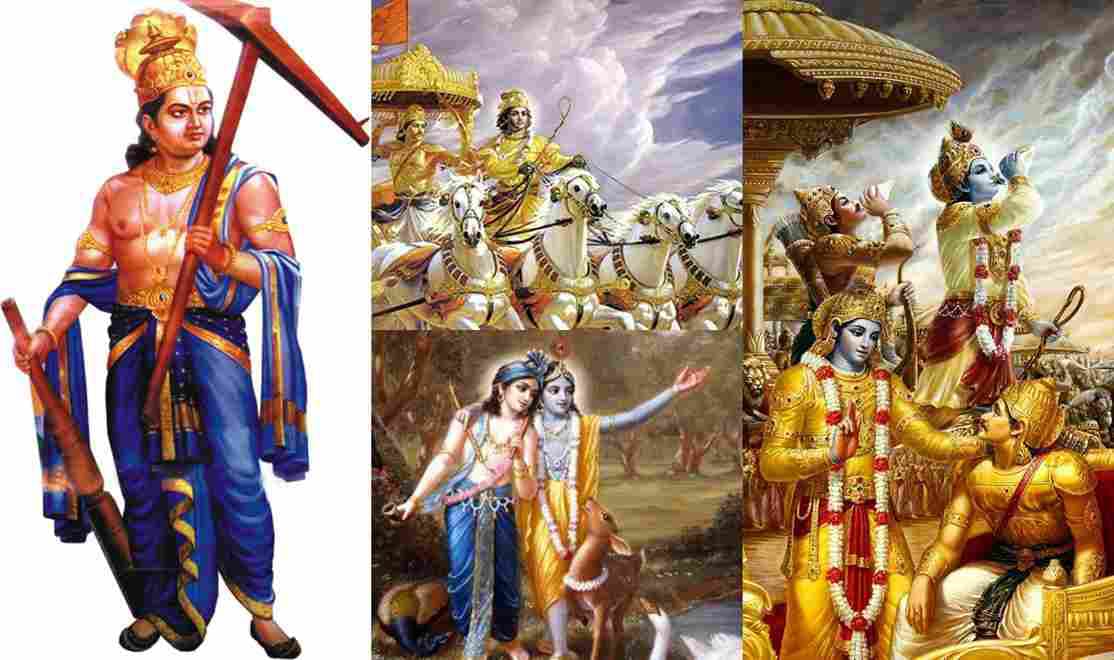
The Mahabharata Tales tells us of the great war fought during the period of Kurukshetra where battles were fought in the name of dharma. Yet, not every powerful warrior chose the battlefield. The story of Balarama in Mahabharata presents one of the most intriguing dilemmas, as Balarama, the elder brother of Krishna, decided — despite his immense strength, influence, and authority — to abstain from the war entirely, choosing neutrality over conflict.
Table of Contents
The Mahabharata Tales: A Story of Duty and Dilemma
In The Epic Mahabharata, there are many warriors and characters that chose to pick up arms and fight for dharma. But even with the intense battle in Kurukshetra, there was one warrior portrayed to have tremendous strength that decided to pick peace over war- Balarama, as unlike his younger brother Krishna who actively aided the Pandavas, Balarama decided to not take part in the war at all. What made him choose not to partake in a war that determined the fate of Bharatavarsha?

See similar posts on YouTube : Click here
Balarama in Mahabharata: The Wise and Neutral Elder Brother
Balarama in Mahabharata characters is indeed one of the unique ones. He is the elder brother of Krishna and therefore he too earned reverence and respect. He had skills in mace and plow weapon fighting with the skill to teach warfare to both Duryodhana and Bhima. Still, during the time of the Kurukshetra War, Balarama sided with neither the Pandavas nor the Kauravas. The reason? He had fond feelings towards both.
Also read: 5 Leadership Lessons from Indian Epics: Learn from Rama and Arjuna
Balarama’s Participation in War : A Conscious Abstention
Balarama, unlike many other warriors, had the vision not to partake in needless slaughter. He knew full well that the war would lead to destruction of an unfathomable proportion. His heart was torn, for Balarama had equal love for both the factions in the war, the Pandavas and the Kauravas. Balarama’s Participation in war would not make any outcome because had trained both Bhima and Duryodhana, making it impossible to take up arms against either. Choosing neutrality, he embarked on a pilgrimage during the war, avoiding involvement in the brutal conflict.
Also read: Ashwatthama’s Gem: The Curse That Changed Everything
Krishna and Balarama: Two Brothers, Two Paths
Difference between Krishna and Balarama during the battle is notable. Krishna, the competent strategist, aligns himself and instructs Arjuna, so that the Pandavas would win. In contrast, Balarama, as expected, opted for detachment. This choice underlines their different impressions- Balarama adopted non-violence and neutrality while Krishna was devoted to the dharma.

Indian Mythology’s Take on Balarama’s Decision
In Indian mythology, Balarama is often portrayed as the ultimate personification of perseverance and virtue. His opting to sidestep the battle further strengthens his persona as a guardian rather than a wreaker of havoc. Some stories even say that he could not tolerate the Kshatriya style of fighting, choosing to flee the spiritless war instead of engaging in conflict.
Also read: Ramayana/ Mahabharata Character Analysis: Crownless Legends of Indian Epic Characters
FAQs
1. Why did Balarama refuse to fight in the Kurukshetra War?
Balarama chose neutrality because he had deep affection and close relationships with both the Pandavas and the Kauravas. Rather than taking sides in a destructive conflict, he preferred to stay away from the battlefield and maintain balance.
2. What was Balrama in Mahabharata known for?
Balrama in Mahabharata is known as the elder brother of Krishna, a powerful warrior, and a master of mace fighting (gada-yuddha). He is also respected for his strong moral principles and commitment to dharma.
3. Did Balarama support the Pandavas or the Kauravas?
Balarama did not openly support either side. Although he had a special bond with Duryodhana as his student and also cared for the Pandavas, he remained neutral throughout the war.
4. Where was Balarama during the Kurukshetra War?
Instead of Balarama’s participation in war, he went on a pilgrimage (tirtha-yatra). This decision allowed him to avoid choosing between loved ones while maintaining spiritual discipline.
5. What was Balarama’s reaction to Bhima and Duryodhana’s final duel?
Balarama was displeased with Bhima’s strike below Duryodhana’s waist during the mace duel because it violated traditional combat rules. This moment highlights his strong adherence to fairness and warrior ethics.
6. Is Balarama considered an avatar in Hindu mythology?
Yes, Balarama is often regarded as an incarnation of Shesha (the cosmic serpent) and is also worshipped as an avatar connected to Lord Vishnu in many traditions.
Final Thoughts
Balarama’s decision will teach people many valuable lessons, such as the great power of restraining violence, especially when one chooses not to engage. Indeed, while all the positions he takes can be considered controversial, his particular position regarding the summons from the Epic Mahabharata was rational and adequate. It is plausible that conflict can sometimes be a solution to issues, but it is important to know when to walk away simply.
Would you have chosen to fight or walked the path of Balarama? Let us know your thoughts!
Follow us: