This page may contain affiliate links. Purchases made through these links may earn a small commission at no additional cost to you. This helps support the platform and maintain high-quality content.
Very few modern Indian novels have truly transformed the way mythology is experienced today. Some stories goes beyond simple retelling, reimagining mythological narratives as a compelling blend of historical fantasy, philosophy, politics, and human choice.
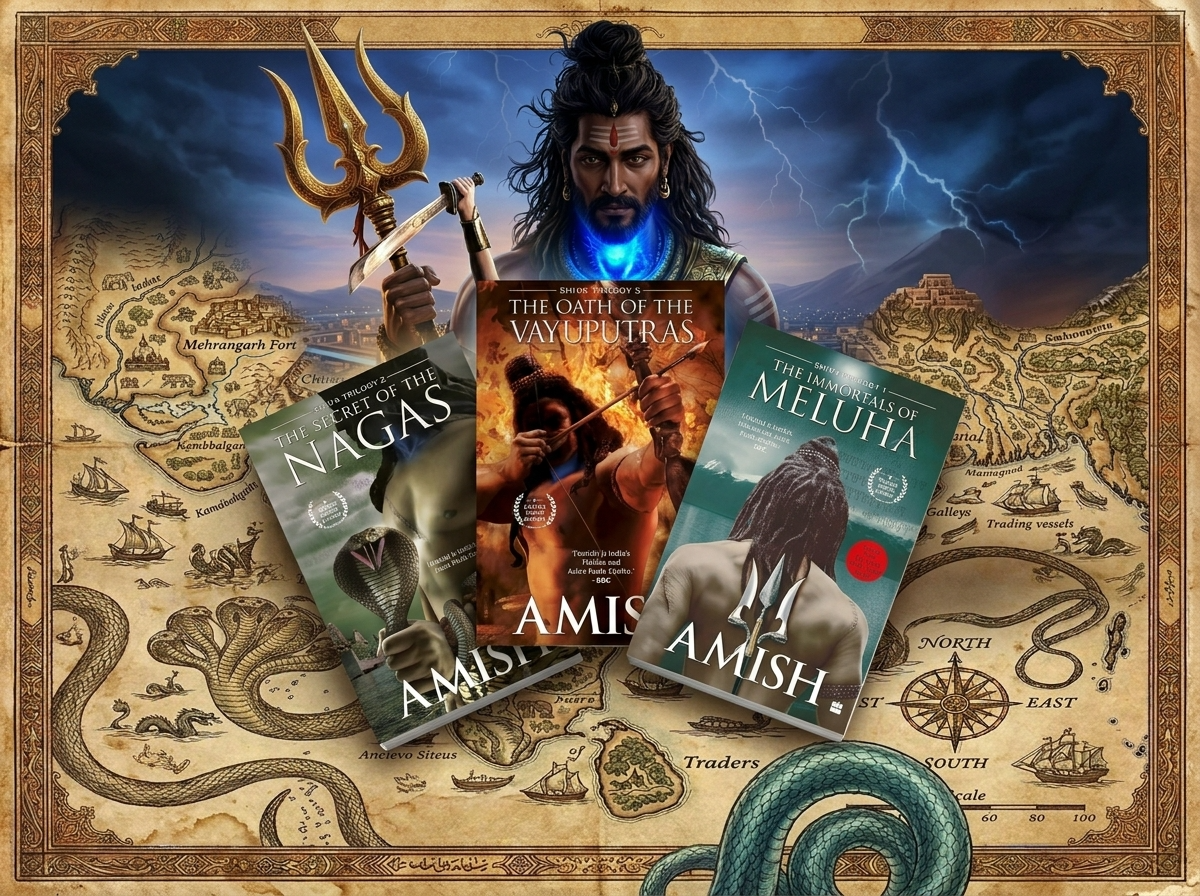
Shiva trilogy Book cover featuring The Immortals of Meluha by Amish Tripathi
In the second installment of our special Saturday Series, we dive into this bestselling saga by India’s own “Tolkien,” Amish Tripathi. While the primary focus will be on Part 1, The Immortals of Meluha, the discussion will also extend to a broader literary analysis of the trilogy as a whole.
Table of Contents
About the Shiva Trilogy Book
A mythological-fiction saga set in a reimagined ancient India, the Shiva trilogy Book explores the journey of a mortal man who rises to become a legend. Blending history, philosophy, and action, it presents gods as extraordinary humans shaped by their decisions.

Shiva Trilogy Book Snapshot
- Title: The Immortals of Meluha
- Author: Amish Tripathi
- Genre: Historical fantasy, mythological fiction
- Published: February 2010 (later reprint September 2010)
- Pages: ~410–420 pages
- Reading Time: 8–12 hours (full trilogy ~30–40 hours)
- Overall Rating: ~4.0–4.3/5 across major platforms
The Shiva trilogy Book stands out for its accessibility and mass appeal, bringing mythological storytelling into mainstream Indian fiction with a modern narrative voice.
Also read: Amish Tripathi Books and Best Works: Complete Guide 2026
The Immortals of Meluha Review
The first installment of the Shiva trilogy Book, The Immortals of Meluha, introduces a carefully constructed world inspired by the Indus Valley Civilization. Shiva begins not as a god, but as a tribal leader from Tibet—flawed, practical, and fiercely loyal.
When he arrives in Meluha, a highly organized Suryavanshi empire, he is declared the prophesied “Neelkanth” after a ritual turns his throat blue. This moment sets the narrative in motion, but what follows is more than prophecy—it’s a philosophical exploration of power and morality.
Also read: Percy Jackson Movie Vs Book Analysis 2026: What’s Best and What’s not
What makes The Immortals of Meluha compelling is how it questions rigid systems. The Vikarma system, for instance, exposes the darker side of a seemingly perfect society. Shiva’s evolving relationship with Sati adds emotional depth, turning the story from political intrigue into something deeply personal.
Rather than offering a clear hero-villain divide, the book slowly dismantles that idea. By the end, the reader is left questioning the very definition of evil—an idea that becomes central to the Shiva trilogy Book.
See more content on our Youtube
Shiva Trilogy Literary Analysis
Themes & Message
At its core, the Shiva trilogy Book argues that gods are not born—they are made. This reinterpretation aligns with the idea that extraordinary humans, through their actions, become divine.
A major theme is the shifting boundary between good and evil. Meluha, despite its perfection, hides systemic flaws, while its enemies—the Chandravanshis and Nagas—are given depth and justification. This layered morality makes the Shiva Trilogy Analysis intellectually engaging. The trilogy also explores dharma, free will, and the consequences of blind faith. It repeatedly suggests that even good systems can become oppressive if left unquestioned.
Also read: Stephanie Garber: Complete Guide to Her Magical Books & Universe
Character Analysis
Shiva is written as a relatable protagonist—impulsive, emotional, yet deeply principled. His transformation from a tribal chief to Mahadev feels earned, not imposed. Sati stands out as one of the strongest characters in the Shiva trilogy Book. A warrior and a Vikarma, her story challenges societal norms while adding emotional weight to the narrative.

Parvateshwar represents the transition from rigid loyalty to moral awareness, while characters like Daksha and Bhrigu highlight the dangers of power without accountability. Even the Nagas, initially portrayed as antagonists, are humanized—a key strength of the Shiva Trilogy Analysis.
Writing Style & Narrative
The writing style of the Shiva trilogy Book is fast-paced and accessible. Amish Tripathi uses simple language, making the series approachable for a wide audience. However, the use of modern slang in a mythological setting divides readers. While some appreciate its relatability, others find it breaks immersion. Structurally, the trilogy follows a clear arc—setup, expansion, and resolution—making it easy to follow despite its scale.
Standout Elements
One of the strongest aspects of the Shiva trilogy Book is its world-building. The mapping of fictional regions to real Indian geography creates familiarity while maintaining creative freedom.
The philosophical dialogues elevate the narrative beyond action. Conversations around karma, love, and justice add depth rarely seen in mainstream fiction. Most importantly, the humanization of Shiva makes the story emotionally engaging, allowing readers to connect with a figure often seen only in divine terms.
Also read: Hermione Granger’s Transformation in Harry Potter: From Rebel to Loyal Sidekick
Criticism
Despite its popularity, the Shiva trilogy Book is not without flaws. Critics often point to repetitive dialogue and uneven prose. Some plot resolutions feel convenient, especially when major societal changes happen quickly. Additionally, the modern tone may not appeal to readers expecting traditional mythological storytelling. Still, these criticisms rarely overshadow the overall impact highlighted in most Shiva Trilogy Review discussions.
Also read: His Dark Materials Trilogy Review: A Philosophical Fantasy That Redefined Modern Storytelling
Is the Shiva Trilogy Worth Reading?
If you enjoy mythological retellings with a modern twist, the Shiva trilogy Book is absolutely worth reading. It works especially well for readers who want:
- A fresh take on Indian mythology
- A balance of action and philosophy
- Emotionally driven storytelling
However, readers who prioritize literary prose and cultural portrayal over storytelling might find it less satisfying. Still, the series remains a defining work in modern Indian fiction.

Shiva Trilogy Ratings
- Story: 9/10
A layered narrative that evolves with each book, keeping emotional and philosophical stakes high. - Characters: 8/10
Memorable leads, though some secondary characters lack depth. - Writing: 7/10
Accessible but occasionally repetitive and tonally uneven. - Impact: 9/10
A culturally significant series that revived interest in mythological fiction.
Also read: Hell House Story: The Dark Psychology Behind Horror’s Most Controversial Haunted House
Shiva Trilogy Review: Overall Verdict
Reading the Shiva trilogy Book feels like stepping into a moral debate disguised as an epic story. It challenges beliefs, questions systems, and humanizes divinity.The emotional arc—especially Shiva’s transformation and loss—lingers long after the final page. More than entertainment, it offers perspective on duty, love, and the consequences of power. For many readers, it becomes a gateway into Indian mythology, but with a modern lens that feels relevant and thought-provoking.
Should You Buy The Shiva Trilogy?
If you’re looking for a mythology-based series that blends storytelling with philosophy and modern narrative style, The Shiva Trilogy by Amish Tripathi stands out as a strong pick.
This series is not a traditional retelling. It reimagines Lord Shiva as a human hero, building a world that feels both ancient and relevant. The writing is simple, the pace is engaging, and the themes—duty, karma, good vs evil—are easy to connect with.
FAQs
Q: Is the Shiva trilogy Book beginner-friendly?
Yes. The writing is simple and engaging, making it accessible even if you’re new to mythological fiction. Prior knowledge enhances the experience but isn’t necessary.
Q: Is The Immortals of Meluha the best book in the trilogy?
For many readers, yes. It has the strongest pacing and world-building, making it the most widely appreciated installment in the series.
Q: Does the Shiva trilogy Book follow real mythology?
Not exactly. It’s a fictional reinterpretation inspired by mythology, presenting gods as historical figures shaped by human choices.
Q: Is the language too modern?
It depends on preference. Some readers enjoy the relatability, while others feel it disrupts the mythological atmosphere.
Q: Are adaptations of the Shiva trilogy planned?
Yes. Filmmakers like Shekhar Kapur have discussed web-series adaptations, showing ongoing interest in bringing the story to screen.
Final Thoughts
The Shiva trilogy Book is not perfect—but it is impactful, engaging, and culturally important. It bridges mythology and modern storytelling in a way few Indian novels have managed.
If you’re looking for a story that blends action with philosophy and emotion, this trilogy delivers. It entertains, but more importantly, it makes you think.
If you enjoy discovering powerful stories like this, join our Saturday Reads Club—it’s completely free and built for readers who want more than just summaries.